Renovating a shell pool: osmosis, bleaching, cracks
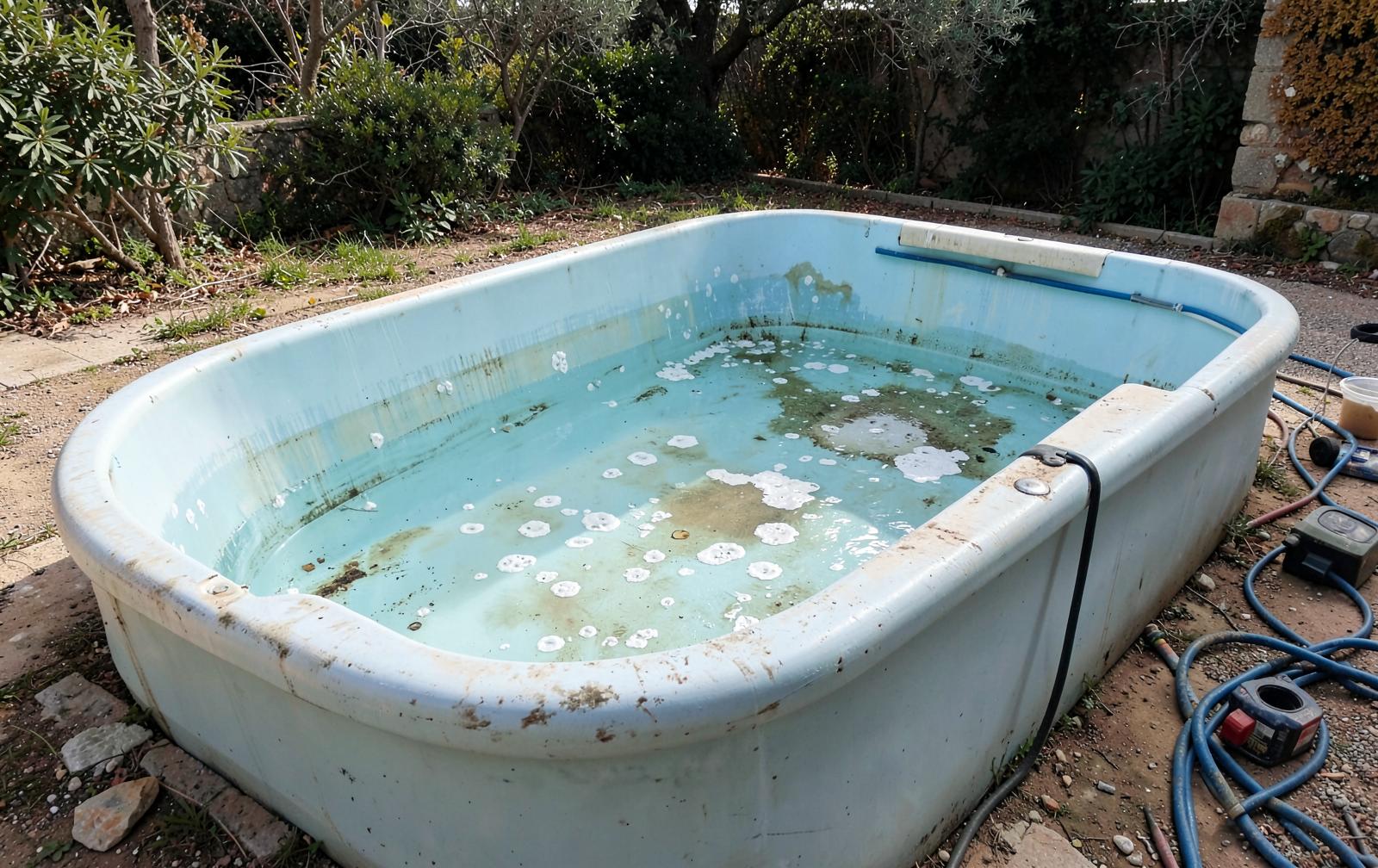
Has your shell pool lost its luster, bleached, or shown blisters? This is common for polyester shells after 15 to 20 years of Mediterranean sun. Good news: in the vast majority of cases, it can be renovated without replacement. Here is how.
The three classic ailments of an aging shell
- Bleaching: the gelcoat (the blue or white finish layer) fades and becomes porous under UV rays. This is the most common sign and the simplest to treat.
- Osmosis: small blisters appear under the surface; water has penetrated the laminate. Concerning to the eye, but it is treated by sanding and drying if caught in time.
- Cracks and crazing: around skimmers, steps, or corners. These deserve a professional opinion as they may signal shell movement.
Renovate or replace: the real question
We only replace a shell in two cases: a major structural crack through the laminate, or a shell whose shape has moved (ground settlement, pressure). It is rare.
In all other cases — osmosis, bleaching, cracks, stains — renovation is enough: full sanding, treatment of osmotic areas, then a new finish layer (gelcoat or top coat). The result is stunning and lasts for 10 to 15 years.
The technical visit serves precisely to decide between the two, before any quote.
How does a shell renovation work?
The typical process:
1. Draining and full cleaning of the basin. 2. Sanding the tired gelcoat, opening and treating osmotic blisters. 3. Drying — a step the Var climate makes easier than elsewhere. 4. Application of the new finish in several layers. 5. Refilling and rebalancing.
Count on generally one to two weeks of work, including drying. Again, the right time is autumn and winter, mild and dry in our region.
And the embedded parts?
A shell renovation is the ideal time to take care of what's aging around it: skimmers, return jets, spotlight, coping stones. A leak on an embedded part is often confused with a shell problem — we test them systematically during the diagnostic, sometimes with targeted leak detection.
If your project is broader (deck, equipment, finish), our pool renovation page presents the complete approach, with a fixed quote before any work.
How to prolong the life of your shell?
- Keep a stable pH between 7.0 and 7.4: acidic water attacks the gelcoat.
- Never drain alone: an empty shell can move under ground pressure. Always with professional support.
- Brush regularly: a clean surface ages much better.
- Watch the waterline: this is where the gelcoat tires first.
Free photo diagnosis
Blisters, stains, or bleaching? Send photos: we'll tell you what's hidden and if a renovation is enough.
3 minutes, no sign-up. You get an initial view and a clear recommendation — no strings attached.
Start my diagnosisFrequently asked questions
Is osmosis on a shell serious?+
No, if it's treated. The blisters are opened, the laminate dries, and the new finish seals everything. Left as is for years, osmosis eventually weakens the structure — hence the value of taking care of it early.
How long does a shell renovation last?+
A newly applied gelcoat, well done, lasts 10 to 15 years, provided you maintain balanced water. It is the water balance that makes the difference, more than the product itself.
Can you change the color of a shell?+
Yes. Renovation is the opportunity to switch from a classic blue to white, sand, or grey. It's the same process; only the finish tint changes.
When to renovate a shell in the Var?+
Between October and March: the pool is not in use, and mild temperatures are ideal for the application and drying of resins.
Also worth reading
Renovating a concrete pool: cracks, coating, liner
Cracks, peeling coating, water loss: how to give a concrete pool a second life, and choose between coating, liner, and reinforced PVC.
Read5 minSpotting and locating a pool leak
How to know whether you're really losing water, and what to do next.
Read6 minHow often should you maintain your pool?
Understand when and how to step in to cut down on both work and products.
Read